Neurological Rehabilitation in South Florida

Personalized Support for Brain and Neurological Function

Focus Brain Therapy provides neurological rehabilitation for patients in South Florida who are experiencing cognitive, physical, sensory, or functional changes related to a neurological condition or injury. Our approach begins with evaluation and focuses on how the brain and body are functioning together. Rehabilitation may address areas such as memory, attention, processing speed, balance, coordination, visual processing, reaction time, and cognitive endurance.
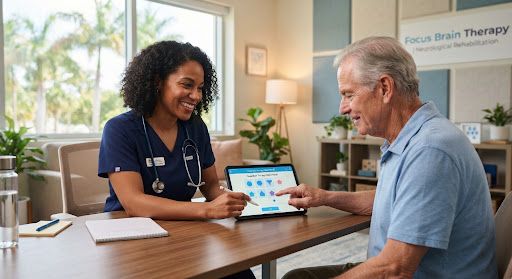
A warm, brightly lit clinical setting with a diverse female therapist gently guiding a senior male patient through a cognitive exercise on a tablet.

A Broader Approach to Neurological Rehabilitation

Neurological conditions can affect people in very different ways. Some patients may be recovering from concussion or traumatic brain injury. Others may be dealing with changes related to stroke, Parkinson’s disease, cognitive decline, or another neurological condition. Because symptoms and functional needs vary, rehabilitation should be individualized. Focus Brain Therapy evaluates current abilities and develops a program based on the patient’s needs, goals, clinical presentation, and ability to participate.

neurology

Areas We May Address

Depending on the individual, neurological rehabilitation may include support for:

  • check_circleAttention and concentration
  • check_circleMemory
  • check_circleProcessing speed
  • check_circleExecutive function
  • check_circleBalance and coordination
  • check_circleVisual processing
  • check_circleReaction time
  • check_circleCognitive endurance
  • check_circleDual-task performance
  • check_circleReturn to work or daily activities
medical_information

Conditions We Support

Patients may seek neurological rehabilitation for concerns related to:

  • arrow_right_altConcussion and post-concussion symptoms
  • arrow_right_altTraumatic brain injury
  • arrow_right_altStroke recovery
  • arrow_right_altCognitive changes
  • arrow_right_altParkinson’s disease
  • arrow_right_altAlzheimer’s disease and dementia
  • arrow_right_altBalance and coordination difficulties
  • arrow_right_altReturn-to-work cognitive challenges
  • arrow_right_altOther appropriate neurological conditions

Note: Each condition requires its own clinical considerations. Our condition-specific pages provide more detailed information.

Cognitive Rehabilitation

Cognitive rehabilitation focuses on areas such as memory, attention, processing, problem-solving, and the ability to manage increasingly complex tasks. For some patients, these challenges may become most noticeable when returning to work, school, driving, exercise, or normal daily routines.

Explore Cognitive Rehabilitation arrow_forward

Cognitive Circuit Training®

Focus Brain Therapy may incorporate Cognitive Circuit Training® as part of an individualized neurological rehabilitation program. This multisensory approach can combine cognitive activities with movement, balance, visual processing, coordination, and reaction-time tasks. The program is adjusted according to the needs and abilities of each patient.

Serving Patients Across South Florida

Focus Brain Therapy works with patients and referral partners throughout South Florida from our Davie location. Patients may be referred by physicians, case managers, rehabilitation professionals, and other healthcare providers, or they may contact our team directly to discuss an evaluation.

Frequently Asked Questions

What is neurological rehabilitation? expand_more
Neurological rehabilitation is designed to support people experiencing changes in brain or nervous-system function. Depending on the individual, rehabilitation may address cognition, balance, coordination, visual processing, reaction time, movement, or functional abilities.
Who may benefit from neurological rehabilitation? expand_more
People recovering from concussion, traumatic brain injury, stroke, or other neurological conditions may be appropriate for evaluation. Some patients also seek support for memory, balance, cognitive function, or return-to-work challenges.
How is neurological rehabilitation different from cognitive rehabilitation? expand_more
Neurological rehabilitation can address a broader range of brain-body functions, while cognitive rehabilitation focuses more specifically on areas such as memory, attention, processing speed, executive function, and cognitive endurance.
Does Focus Brain Therapy use neuroplasticity in rehabilitation? expand_more
Yes. Neuroplasticity provides an important scientific framework for rehabilitation. Focus Brain Therapy uses individualized cognitive, sensory, visual, and movement-based activities to appropriately challenge neurological function.
What is Cognitive Circuit Training®? expand_more
Cognitive Circuit Training® is Focus Brain Therapy’s proprietary multisensory approach that may combine cognitive activities with movement, balance, visual processing, coordination, reaction time, and other neurological demands.
Do I need a referral to request an evaluation? expand_more
Patients may contact Focus Brain Therapy directly to discuss an evaluation. Referral and authorization requirements can vary depending on insurance, workers’ compensation, or the individual clinical situation.
Does neurological rehabilitation guarantee recovery? expand_more
No. Outcomes depend on the individual, diagnosis, severity, medical history, functional abilities, and other factors. Focus Brain Therapy does not guarantee a particular outcome or recovery timeline.

Start With an Evaluation

If neurological symptoms are affecting memory, attention, movement, balance, work, or everyday function, an evaluation can help provide a clearer understanding of what may need additional support.

Neurological rehabilitation is individualized and does not guarantee a specific outcome or recovery timeline. Focus Brain Therapy services are intended to complement appropriate medical care. Diagnosis, medication management, emergency treatment, and other physician-directed medical services should remain coordinated with the appropriate healthcare professionals.
Website built with pressless