A concussion can affect more than how your head feels. Some people notice that thinking takes more effort, conversations become harder to follow, familiar tasks take longer, or mental energy disappears faster than it did before the injury.
These changes are often described as brain fog, memory problems, difficulty concentrating, slower thinking, or cognitive fatigue.
The Centers for Disease Control and Prevention recognizes concentration problems, feeling slowed down or foggy, memory difficulties, and trouble thinking clearly among possible symptoms of mild traumatic brain injury or concussion.
Many people improve over time. When cognitive symptoms continue, interfere with everyday activities, or become more noticeable when returning to work, school, sports, driving, or other responsibilities, further evaluation may be appropriate.
Why Can a Concussion Affect Thinking and Memory?
A concussion is a form of mild traumatic brain injury. Symptoms vary from person to person and can affect thinking, physical function, emotions, and sleep.
Cognitive symptoms may include:
- Difficulty maintaining attention
- Forgetting conversations or instructions
- Slower information processing
- Losing track of tasks
- Difficulty multitasking
- Trouble planning or organizing
- Mental fatigue
- Feeling overwhelmed in busy environments
These difficulties are not always obvious to other people.
Someone may appear physically recovered while still struggling during meetings, lengthy conversations, schoolwork, computer use, decision-making, or other mentally demanding activities.
How Long Can Brain Fog Last After a Concussion?
There is no single recovery timeline.
The CDC reports that most people with mild TBI or concussion improve within a relatively short period, while some experience symptoms for weeks, months, or longer. It recommends talking with a healthcare provider when symptoms do not resolve within two to three weeks or become worse after returning to regular activities.
Persistent cognitive symptoms should not simply be dismissed.
They also should not automatically be attributed entirely to the concussion. Sleep problems, headaches, pain, medications, anxiety, vision or vestibular problems, fatigue, and other factors can influence cognitive performance.
Evaluation can help identify what may be contributing to the difficulty.
What Is Cognitive Rehabilitation?
Cognitive rehabilitation is a structured approach used to address cognitive difficulties and how they affect everyday function.
Depending on the individual, rehabilitation may address:
- Attention
- Memory
- Processing speed
- Executive function
- Planning
- Organization
- Problem-solving
- Self-monitoring
- Cognitive endurance
Cognitive rehabilitation is more than completing puzzles or computerized “brain games.”
The goal is to understand how cognitive challenges affect meaningful activities and use appropriate strategies, practice, feedback, environmental changes, and functional tasks to support improvement or compensation.
Current cognitive rehabilitation guidance supports individualized approaches that connect treatment to real-world function.
What Can Cognitive Rehabilitation After a Concussion Involve?
Treatment should be based on the individual rather than a standard exercise program.
One person may have difficulty sustaining attention while using a computer. Another may function well in a quiet room but struggle to follow conversations in a busy environment. Someone else may perform well for short periods but experience significant cognitive fatigue as demands increase.
Depending on the person’s needs, rehabilitation may involve:
- Memory strategies
- Sustained or divided attention
- Sequencing
- Decision-making
- Task switching
- Problem-solving
- Processing information under increasing demands
- Strategies for managing cognitive fatigue
The goal is not simply to become better at an exercise. Rehabilitation should relate to activities that matter in everyday life.
How Does Neuroplasticity Relate to Rehabilitation?
Neuroplasticity describes the nervous system’s capacity to change and adapt in response to experience, learning, activity, and other influences.
It is an important scientific principle behind rehabilitation.
Neuroplasticity does not mean every neurological injury can be reversed or that a specific outcome can be guaranteed. Instead, it helps explain why structured activity, repetition, feedback, learning, and progressively challenging experiences can play an important role in rehabilitation.
At Focus Brain Therapy, these principles help inform individualized cognitive and neurological training through Cognitive Circuit Training®.
The objective is to identify meaningful challenges, establish measurable goals, progressively challenge relevant abilities, and monitor how the individual responds.
When Should You Consider a Cognitive Evaluation?
Consider discussing evaluation with a qualified healthcare professional when cognitive symptoms continue to interfere with activities that matter to you.
Examples include:
- You cannot concentrate as long as before the injury.
- Work or school requires significantly more effort.
- You frequently forget information.
- Multitasking has become difficult.
- Busy environments become overwhelming.
- You lose your train of thought.
- Mental fatigue limits daily activities.
- Symptoms increase as activity increases.
Evaluation can help identify patterns that may not be obvious during a brief conversation or routine medical appointment.
Returning to Work, School, Sports, and Daily Life
Recovery becomes especially important when normal demands return.
Work may involve concentration, computer use, meetings, multitasking, driving, decision-making, or rapid information processing. Students may need to listen, take notes, remember new information, study, and complete assignments for extended periods.
These activities can reveal cognitive difficulties that are less noticeable at rest.
The CDC recommends a gradual return to regular activities and appropriate healthcare guidance when returning to work, school, driving, sports, and other activities.
Rehabilitation may support this process by progressively challenging cognitive abilities while monitoring performance and symptoms.
Cognitive Rehabilitation in South Florida
Focus Brain Therapy works with individuals experiencing cognitive and neurological challenges, including people recovering from concussion and brain injury.
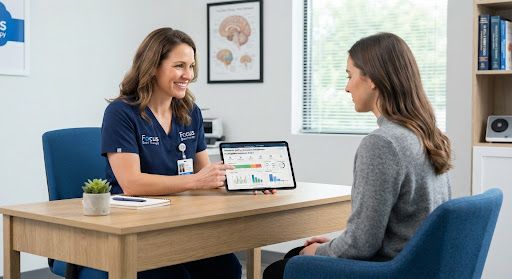
At its brain therapy and rehabilitation center in Davie, Florida, care may include objective assessment, individualized planning, cognitive and brain-body activities, patient education, and Cognitive Circuit Training® based on the needs and goals of the individual.
Cognitive rehabilitation does not replace appropriate medical care. It may function as one component of a broader recovery plan involving physicians and other healthcare professionals when appropriate.
If brain fog, memory problems, difficulty concentrating, or cognitive fatigue are interfering with daily life after a concussion, further evaluation can help determine an appropriate next step.
Contact Focus Brain Therapy to learn more about concussion and cognitive rehabilitation services in South Florida.
How Cognitive Rehabilitation May Support Everyday Function
An individualized rehabilitation plan may use structured activities to challenge specific cognitive abilities while monitoring symptoms, accuracy, speed, endurance, and response to increasing demands.

Focus Brain Therapy’s Cognitive Circuit Training® may combine cognitive exercises with movement, balance, visual challenges, reaction-time activities, and multisensory input when appropriate for the patient.
The program is shaped by the person’s evaluation findings, current abilities, functional difficulties, and goals. Cognitive rehabilitation does not replace appropriate medical care. It may serve as one component of a broader recovery plan involving physicians and other healthcare professionals.
Questions to Ask Yourself After a Concussion
- Am I making memory errors that were unusual before the injury?
- Do reading, computer work, or conversations exhaust me?
- Am I struggling to focus in noisy or busy settings?
- Does it take longer to understand information or make decisions?
- Have I reduced work, school, driving, or social activities because of symptoms?
- Do I feel physically better but remain unable to manage normal mental demands?
- Are my symptoms improving, staying the same, or worsening?
These answers may help you describe the problem more clearly to a healthcare provider.
Areas We Serve
Focus Brain Therapy provides evaluation-led cognitive and neurological rehabilitation from its center in Davie, Florida. The practice serves patients and families from Fort Lauderdale, communities throughout Broward County, and the wider South Florida region.
Patients may seek support following a concussion caused by a fall, motor vehicle collision, sports injury, workplace incident, or another event. An evaluation is required to determine whether Focus Brain Therapy’s services are appropriate for a particular person.
When Should You Schedule an Evaluation?
Consider an evaluation when brain fog, memory problems, trouble concentrating, slower processing, or cognitive fatigue continue to interfere with everyday function after a concussion.
You do not need to determine the precise source of every symptom on your own. An evaluation can help identify how you are functioning now and whether individualized cognitive rehabilitation may be an appropriate part of your recovery plan.
If ongoing symptoms are affecting your work, education, relationships, independence, or quality of life, schedule an evaluation with Focus Brain Therapy.
Frequently Asked Questions
Is brain fog common after a concussion?
Brain fog is a common way of describing symptoms such as feeling mentally slowed down, having trouble concentrating, forgetting information, or struggling to think clearly after a concussion. Symptoms should still be discussed with a healthcare provider.
How long do memory and concentration problems last after a concussion?
Recovery differs for every person. Symptoms may improve gradually, while some individuals experience difficulties that continue to affect daily function. A healthcare provider can assess the symptoms, recovery pattern, and need for additional care.
When should I consider cognitive rehabilitation after a concussion?
Consider an evaluation when cognitive symptoms are not improving, worsen with activity, or interfere with work, school, driving, communication, or daily responsibilities. Rehabilitation should be coordinated with appropriate medical care.
Can cognitive rehabilitation help with memory problems?
Memory is one of several functions that may be addressed during cognitive rehabilitation. The plan depends on the person’s evaluation results, symptoms, functional needs, and goals. No specific outcome can be guaranteed.
Is cognitive rehabilitation the same as brain-training games?
No. Cognitive rehabilitation is broader than completing isolated games. It connects assessment and structured therapeutic activities to practical goals such as working, studying, communicating, organizing tasks, and managing everyday demands.
Can a concussion cause problems even if a CT scan or MRI is normal?
Yes. The CDC explains that brain imaging is not generally used to identify a mild TBI itself, although imaging may be needed when a provider is concerned about bleeding or another structural injury. Diagnosis and care should come from a qualified healthcare provider.
Does Focus Brain Therapy serve patients outside Davie?
Yes. Focus Brain Therapy is located in Davie and serves people from Fort Lauderdale, Broward County, and throughout South Florida. Some patients may also travel to the center for specialized evaluation and rehabilitation.
Do I need emergency care or a rehabilitation evaluation?
Emergency warning signs require immediate medical care. Rehabilitation evaluation is for non-emergency cognitive and functional concerns. Call 911 or visit an emergency department for worsening headache, repeated vomiting, seizures, increasing confusion, weakness, slurred speech, unusual drowsiness, or other concussion danger signs.
Medical note: New or worsening neurological symptoms after a head injury may require urgent medical attention. Seek emergency care for serious warning signs such as worsening headache, repeated vomiting, seizures, weakness or numbness, slurred speech, increasing confusion, unusual behavior, unequal pupils, loss of consciousness, or inability to wake.